PE-Backed Home Services Platform
Across a PE-backed home services platform, two HVAC brands running Arch retention automation reduced churn by 7.0 percentage points from baseline — while nine brands without automation saw churn rise 4.9pp over the same period. That's an 11.9pp spread in 4 months.
The Challenge
This PE-backed platform operates multiple home services brands across the US. Despite strong operational infrastructure, customer churn across the portfolio was rising — and with it, pressure on acquisition budgets to replace lost revenue. Leadership needed a scalable, measurable way to retain customers across brands without adding headcount.
Rising Churn, No Playbook
Multiple brands were seeing HVAC customer churn climb quarter over quarter, but lacked a systematic retention strategy beyond standard renewal reminders.
Acquisition Cost Pressure
Every lost customer had to be replaced through paid channels in order to rejuvenate growth.
The Solution
Two HVAC brands in the portfolio deployed Arch's retention automation engine. The platform connected to ServiceTitan, identified at-risk customers, and launched personalized outreach sequences automatically — no manual campaign management required.
At-Risk Customer Identification
Arch analyzed customer data to identify churn risk signals and customers that had a higher propensity to churn.
Automated Reactivation Sequences
Arch deployed structured reactivation sequences delivering specific value at specific intervals throughout the customer lifecycle — not just at renewal time.
Continuous Measurement
Churn rates were tracked monthly against the October 2025 baseline across all 11 brands — the two running Arch and the nine without automation — creating a natural comparison within the same portfolio and operational environment.
Results
Four-month comparison: Arch retention automation vs. no automation, from the October 2025 baseline.
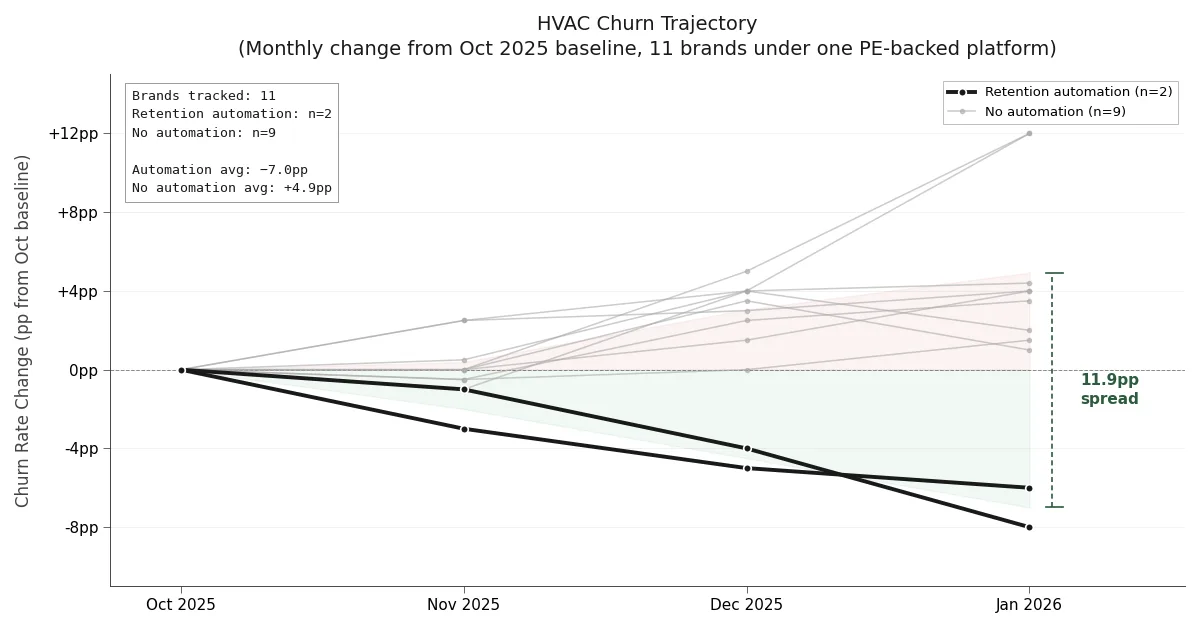
Monthly churn rate change from October 2025 baseline across 11 brands under one PE-backed platform.
Cross-Trade Performance
The retention effect wasn't limited to HVAC. Arch brands outperformed in every trade visible in the dataset.
All values represent average percentage-point change from the October 2025 baseline to January 2026.
Learnings
Automation Created a Clear Divergence
The two brands running Arch retention automation moved in the opposite direction from the rest of the portfolio. While the nine brands without automation saw HVAC churn climb by an average of 4.9 percentage points, the Arch brands reduced it by 7.0pp. This divergence grew wider each month — suggesting the effect compounds over time rather than plateauing.
Same Platform, Different Outcome
All 11 brands operated under the same PE-backed platform with shared operational infrastructure. The key variable was whether the brand was running structured retention automation. This makes the comparison particularly strong — external factors like market conditions, seasonality, and macroeconomic environment were held constant across the group.
Retention Protects Revenue Others Spend to Replace
For PE-backed platforms managing multiple brands, every percentage point of churn translates directly to EBITDA erosion — revenue that must be replaced through increasingly expensive paid channels. A sustained reduction in churn doesn't just protect existing revenue; it shifts the entire growth equation from acquisition-dependent to retention-led.
Frequently Asked Questions
See what retention automation can do for your portfolio.
Get a benchmark on churn, lead coverage, and growth potential — then see where retention automation fits in your lifecycle motion.