How a Follow-Up Call Drives Marketing ROI by 8.4x
Leads that get a follow-up call book at 10.6%. Leads that do not book at 1.3%. A third of sales-ready leads never get called at all.
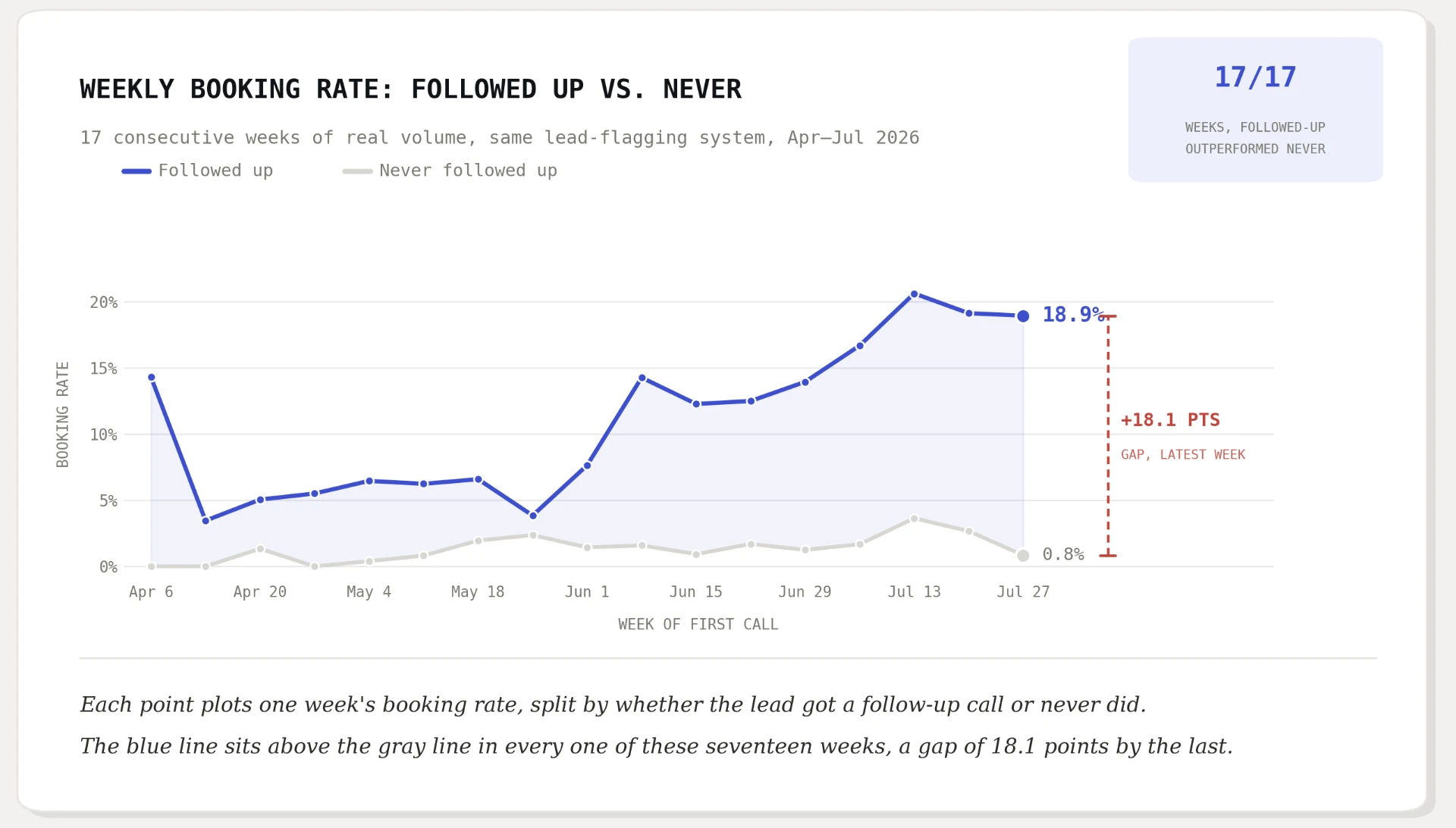
Followed-Up Leads Are 8x More Likely to Book
Arch's Call Intelligence identified 22,096 leads as sales-ready. 33.4% of them never got a follow-up call.
| Followed up | Never followed up | |
|---|---|---|
| Leads | 14,707 | 7,389 |
| Booking rate | 10.59% | 1.26% |
| Avg. revenue per lead | $931 | $127 |
Nothing else changed between these two groups. The only difference was the follow-up.
The speed at which you follow up moves the gap further:
| Called back within 24 hours | Called back after 24 hours |
|---|---|
| 12.1% booking rate | 6% booking rate |
Before You Buy More Leads, Call the Ones You Already Paid For
Marketing finds the opportunity. Your CSRs get the appointment booked, your sales team closes the job, and your techs do the work. When that handoff works, the marketing spend pays off. When a lead sits without a call, you've paid to start a conversation nobody on your team finishes.
Every lead in the table above was identified as sales-ready. Leads that received a follow-up call generated $931 in revenue on average, compared with $127 for those that didn't.
Consider a Texas-based home services company identifying roughly 500 leads a month. At the median follow-up rate of 63%, 185 of those leads receive no outbound call. If those leads performed like the ones that received follow-up, the revenue opportunity would be roughly $149,000 a month, or $1.8 million a year.
The company has already paid to generate that interest. There's still a cost to making the calls and completing the jobs, but it doesn't need another campaign to reach these homeowners. It needs someone responsible for following up, time set aside to make the calls, and a way to see which leads are still waiting.
For a platform, the opportunity extends across every brand with the same gap. More consistent follow-up can add revenue to businesses you already own, and the portion that converts to EBITDA can increase enterprise value. That makes follow-up worth reviewing alongside lead volume, acquisition cost, and campaign ROI. Before approving more marketing spend, know how much of the demand you've already paid for is getting a call.
Give Every Lead an Owner and a Deadline
A cancelled job, an unsold estimate, an unbooked call. Each gives your team a reason to reach out. But identifying the opportunity only helps if someone acts on it.
Ownership makes follow-up part of the job. If everyone can see the lead but nobody is responsible for calling, it's easy to assume someone else will handle it. Give each identified lead a named owner and a deadline. If the comfort advisor or tech can't follow up, inside sales should know when to take over. Back that responsibility with a commission structure that rewards techs and inside sales for follow-ups and creates healthy competition between both functions.
Speed gives that call a better chance. While a lead waits in your queue, the homeowner may be calling another contractor or deciding to put the work off. In this data, booking rates are highest in the first 24 hours and decline from there. Call as soon as possible, and treat 24 hours as the maximum time a lead should wait for a first attempt.
The team needs to know who's calling, by when, and who takes over if that person is unavailable.
The Playbook: Fix the Handoff Before You Fix the Campaign
- Measure how many leads actually get a call. Start with the share of identified leads that receive an outbound attempt, then check how quickly it happens. Break it down by brand and lead type so you can see where follow-up stalls. If a third of your leads go uncalled, factor that into the next marketing budget discussion.
- Make the 24-hour standard workable. Assign coverage for evenings, weekends, and days when the phones won't stop ringing. Give the team time to work the queue and a backup when the usual owner is unavailable. Review overdue leads daily. A deadline only helps if someone has the capacity to meet it.
- Assign an owner before a lead gets lost in qualification. Every identified lead needs someone responsible for reviewing it and making the next move. Some won't warrant a call; record why and close them out. For the rest, track the call attempt and its outcome. Make one person accountable for the overall follow-up rate, so missed leads get addressed before the next campaign adds more.
Where Arch Fits
Arch's Call Intelligence can identify a lead. Closing the gap after that takes either a human process with a real owner, or automating the call itself through an outbound-calling integration. That's where most marketing and attribution tools stop: they get better at finding and scoring leads and then hand it off to whatever process a company happens to have. Most companies aren't just slow to follow up, they tend to have no follow-up process at all.
Arch's roadmap splits this into three layers: intelligence, orchestration, accountability. Intelligence identifies and scores the lead, the layer most tools already compete on. Orchestration is the part most of them skip: routing the identified lead to the right person automatically instead of dropping it into a queue nobody owns. Accountability closes the loop by tracking whether the call happened and what it produced.
Our Hot Leads feature turns lead identification into a live, ranked work list instead of a report nobody opens. Follow-ups, marketing engagement, and unsold estimates all feed one queue, sorted by the highest-value, newest leads at the top instead of getting buried under older ones. That answers both numbers above directly: the 33.4% of identified leads that never get called, and the drop-off after the first 24 hours, because the leads still most likely to convert are the ones a CSR sees first.
See what's sitting in your ServiceTitan data. Get your free revenue diagnostic.
Frequently Asked Questions
Why do sales-ready leads still not get called? Because identifying a lead as sales-ready doesn't assign anyone to call it. Without a named owner and a deadline, the lead just sits in a queue.
Does follow-up speed actually change the booking rate? Yes. Leads called within 24 hours book at 12.1%, versus 6% after 24 hours. The lead doesn't go cold instantly, but it erodes fast.
Is this a marketing problem or a sales problem? Neither on its own. Marketing generates and identifies the lead; whether it converts depends on who follows up after. The gap opens after the identification, not before it.