Why 2 Brands Kept Their Customers While 9 Didn't
Automated retention workflows reduced HVAC churn by 7pp across a PE-backed portfolio, while 9 brands without automation saw churn climb by nearly 5pp. An 11.9pp spread in four months.
How automated retention workflows reduced HVAC churn by 7 percentage points across a PE-backed home services portfolio, while brands without automation saw churn climb by nearly 5.
Written by Philipp Krinner, CEO & Co-Founder of Arch AI
Last Updated: March 2026
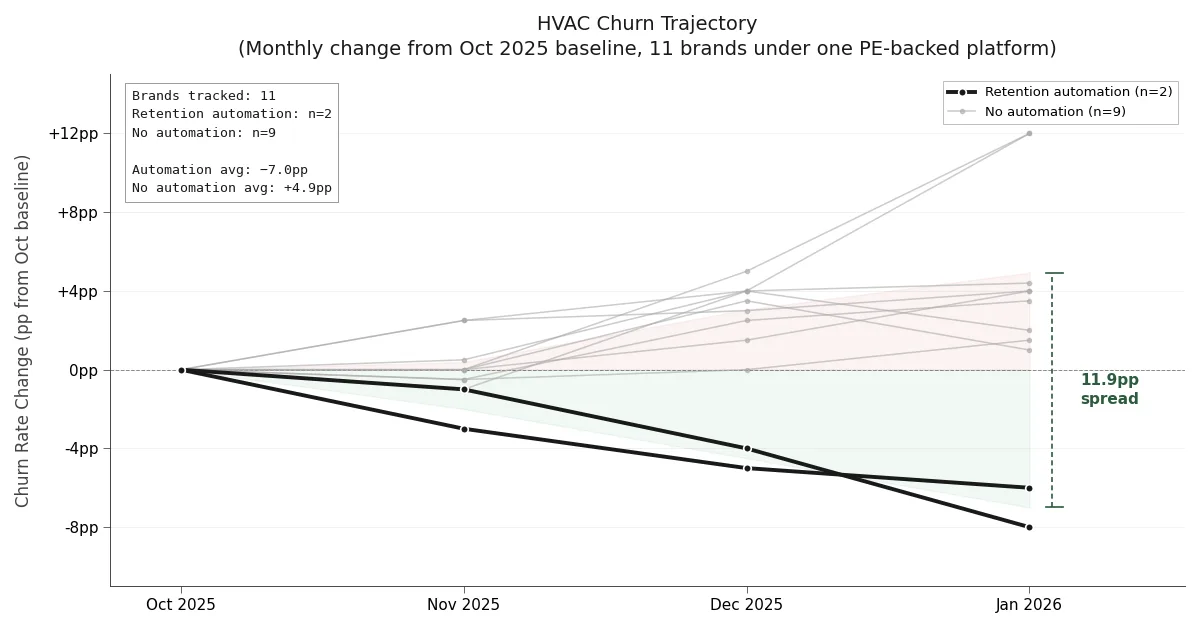
The two brands running automation reduced HVAC churn by an average of 7.0 percentage points. The nine brands without it saw churn increase by an average of 4.9 percentage points. That's an 11.9 percentage point spread in four months, across brands operating inside the same portfolio.
What the Retention Automation Actually Does
This isn't about sending more emails. The brands that lost customers were already marketing to them. The difference is what they were marketing and when.
The two brands that improved were running structured retention sequences that delivered specific value at specific intervals:
Maintenance reminders tied to equipment age and service history. Not a generic "it's been a while." A message that says "your system was installed in 2017 and hasn't had a tuneup since March" is useful information, not marketing noise.
Membership benefit reminders before renewal. Most members forget what they're paying for by month 8. The top-performing brands in this study reminded members of unused benefits, upcoming seasonal checkups, and priority scheduling status throughout the year — not just at renewal time.
Seasonal preparation checklists. Practical content: "here are 3 things to check before your first heating day" or "your filter is due for replacement based on your last service date." These emails get opened because they help the homeowner, not because they have a coupon.
Equipment-specific safety and efficiency tips. Personalized to the actual system in the home, based on technician notes and service history. A customer with a 12-year-old heat pump gets different content than one with a 3-year-old furnace.
The pattern is consistent: every touchpoint creates value for the homeowner. Nothing in the sequence asks for a sale. The sale happens because the customer trusts the company when something does break.
Why the Other 9 Brands Lost Ground
The nine brands without automation were not ignoring their customers. Most were running seasonal campaigns, holiday promotions, or periodic email blasts. Standard marketing.
The problem is that standard marketing treats every customer the same. A customer approaching their 13th month gets the same message as one who just had service last week.
Without automation tied to customer data, there's no mechanism to intervene at the right moment with the right message. The intent is there. The system isn't.
Process Enforcement, Not Marketing Brilliance
The brands that succeeded didn't have better marketers. They had better process enforcement.
Automation meant that every customer received the right sequence at the right time, regardless of whether someone on the marketing team remembered to send it. It ran in the background, continuously, across every customer in the database.
The brands that fell behind were relying on manual campaign planning, seasonal pushes, and team bandwidth. When bandwidth shrank, outreach stopped. When outreach stopped, customers left.
At portfolio scale, this compounds fast. A 10-location platform with 10,000 active customers per location losing an additional 4.9 percentage points per year is roughly 490 more customers walking out the door, every year, at each location. That's 4,900 customers across the platform.
How This Compares to Industry Benchmarks
For context: our Q4 2025 study across 85+ home services companies found that best-in-class operators churn just 7% of customers annually. The industry average sits at 40%. The 11.9 percentage point spread observed in this portfolio study is consistent with that broader benchmark data: the gap between companies that systematize retention and those that don't is large, measurable, and persistent.
Similarly, 74% of home services memberships cancel at first renewal. The brands in this study that delivered continuous value between service visits avoided that cliff. The ones running standard annual renewal campaigns did not.
The EBITDA Impact for PE-Backed Platforms
For PE-backed platforms managing multiple brands, customer churn is not a marketing problem. It's an EBITDA problem.
Every customer lost must be replaced through acquisition, at roughly 13x the cost of retaining an existing one. A portfolio of 10 brands each losing an incremental 5 percentage points of customers annually represents millions in eroded recurring revenue and millions more in replacement acquisition spend.
The fix is not more marketing budget. It's systematic value delivery: the right message, to the right customer, at the right time, running automatically across every brand in the portfolio.
The Takeaway
Customers don't leave because they had a bad experience. Most leave because they had no experience. The gap between their last service visit and their next need was filled by a competitor who showed up with something useful at the right time.
The two brands that held their customers didn't do anything revolutionary. They systematized value delivery. Maintenance reminders, benefit recaps, seasonal prep, equipment-specific guidance. Useful content, personalized to the customer, delivered automatically.
The nine that didn't saw churn climb every month.
The data doesn't leave much room for interpretation. Retention at scale requires automation. Not because automation is clever, but because humans can't remember to reach 50,000 customers at the right moment with the right message. Systems can.
Frequently Asked Questions
What is a good customer retention rate for home services companies?
Based on Arch's Q4 2025 study of 85+ home services companies, best-in-class operators retain approximately 93% of customers annually (7% churn rate). The industry average is significantly lower, with approximately 40% annual churn. The gap represents substantial revenue impact, particularly for multi-brand platforms.
How does automated retention compare to manual marketing campaigns?
In this study, brands running automated retention workflows reduced churn by 7 percentage points over four months. Brands running standard manual campaigns (seasonal promotions, periodic email blasts) saw churn increase by 4.9 percentage points over the same period. The key difference is that automation delivers personalized, data-driven outreach continuously, while manual campaigns depend on team bandwidth and tend to treat all customers the same.
What does effective HVAC customer retention automation include?
The most effective retention programs in this study included four elements: maintenance reminders tied to actual equipment age and service history, membership benefit reminders delivered throughout the year (not just at renewal), seasonal preparation checklists personalized to the customer's system, and equipment-specific safety and efficiency tips based on technician notes.
How much does customer churn cost a PE-backed home services platform?
Customer acquisition costs approximately 13x more than customer retention. For a 10-location brand with 5,000 active customers, each additional percentage point of churn represents roughly 50 lost customers per year. Across a portfolio of multiple brands, incremental churn translates to millions in lost recurring revenue and increased acquisition spend.
How does Arch AI help home services companies reduce churn?
Arch connects to ServiceTitan in view-only mode and analyzes customer data to identify churn risk, membership retention gaps, and revenue opportunities. The platform automates personalized retention outreach across email and direct mail, and provides holdout-tested attribution to prove incremental ROI. Learn more about how Arch connects to ServiceTitan.
Arch AI helps home services companies drive organic growth through retention diagnostics, automated outreach, and AI-powered lead discovery. The platform integrates with ServiceTitan and is used by PE-backed platforms and large independents across the US. Learn more at getarch.com
Further reading: